
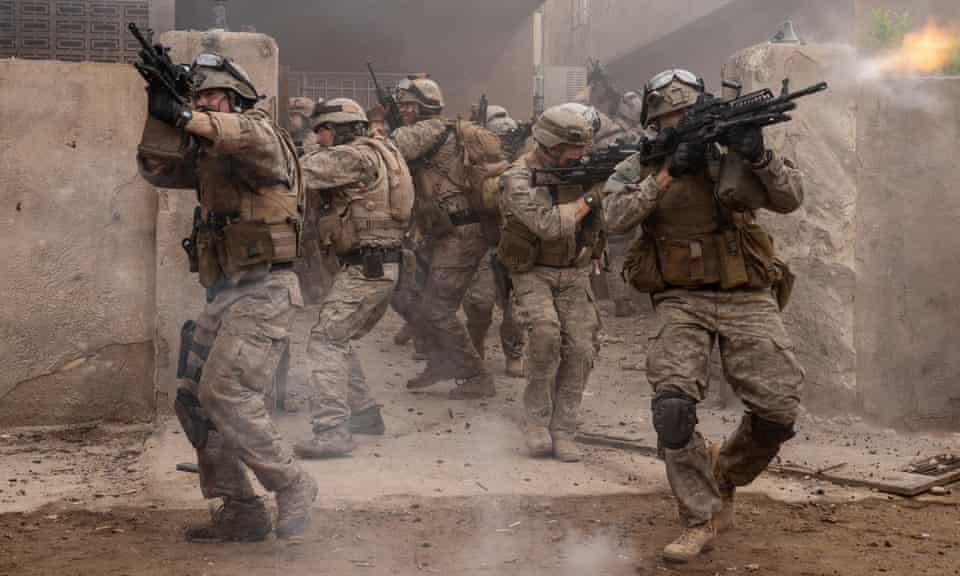
Alex Garland’s next film after his fictitious “Civil War” dials back the scope and morality themes to focus on a true event, a real encounter a Navy Seal insurgent team had in the Iraq War in November 2006. A day in the life sort of storytelling that many would regard as a confined-setting film. Here Garland forces the audience to not just be a witness to the ominous event, he wants the audience to feel they are engaged, that they are there. To really feel you are there. And leave you raw, and gut punched.
Garland doesn’t waste time and drops us into the setting without much exposition. After that he keeps a hasty speed that, surprisingly, doesn’t race to its ninety-five minute brisk completion. Warfare is a slice of a day or two of a navy seal team barricaded in a house, surrounded, and then goes bad, then goes awful. Within its time we do get a sense of each individual character and personality, each seasoned to war in their own unique way except one. “He’s got new guy energy.” Say one of them when a fresh-face anxious soldier in the room. It says it all with the kind of team we are emenced with. What wonderfully works in this film is Garland not only presents the horrors with an unflinching eye, but also the unnerving quiet, the waiting that occurs. The rush and wait, that many in the military refer to as. The film also shows us the un-smoothness of war engagement. Especially the difficulty to see with dust and debris from artillery or gunfire, to the confusion of difficulty of hearing or communicating.
Warfare isn’t here to make any moral claim about war, or the politics that lead to it. What Warfare shows us is the absolute destruction, and death that what occurred. It shows us what is left behind is rather insignificant to the overall scale of the whole war together even though what occurred is devastating. Warfare isn’t invoking any challenges or changes of what you think of war. It just, what occurred and could have all been forgotten if Mendoza wasn’t a military consultant on “Civil War” and told Garland. And that’s what it brings. All the little intricacies that happen in a war that films generally disregard and deemed unimportant to tell and that what makes it stand out. Overall, Warfare shows us that all that are involved in war, willing or unwilling have to pay a toll one way or the other. 8/10

 St Paul Filmcast Reviews
Leave a comment