
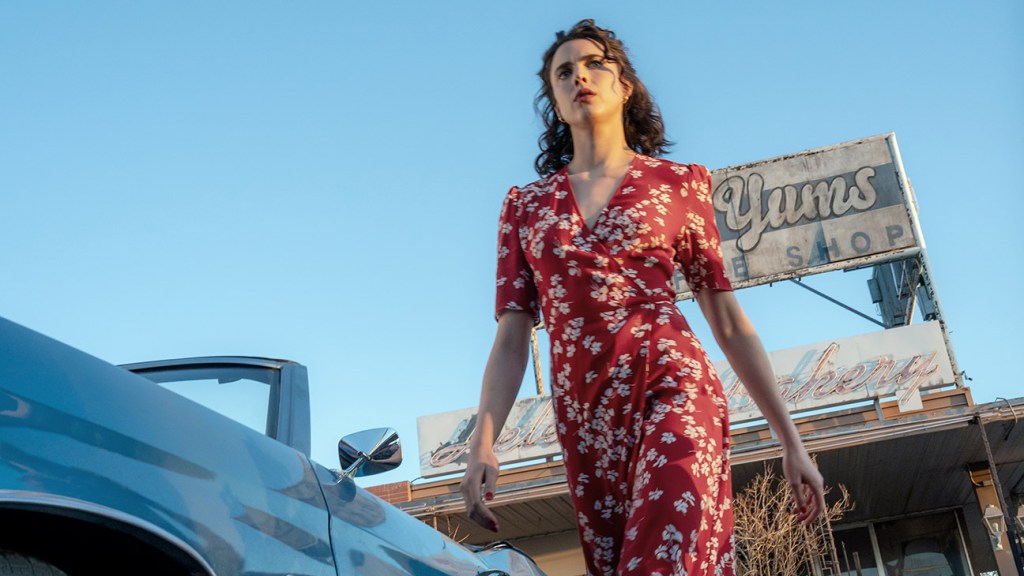
Private Investigator Honey O’ Donahue is calm, collected, amazingly dressed, and looking for love in all the wrong places. She oozes confidence, and walks with purpose. She is also quick with a vocal jab- remarking to someone after they found her clever to wait to read the riddle tattooed on his ass. Her comprehensive approach is never in question, all while also it seems never to get paid for her services. She is in full contrast to the menagerie of questionable, slimy outrageous characters that dwell in a rundown California town. All of them trapped in the confinements of the city border and in their own individual hypocrisy. The film could be clearly defined as a post-neo-noir film. A mixture of the gritty realism of a neo-noir, and the surreal fever dream of film noir. Combining both earmarks of both neo-noir and film noir Ethan Coen is leaving behind the style of only neo-noir he did with his brother Joel like “Blood Simple” and “ Miller’s Crossing” and the forgotten “The Man Who Wasn’t There.” All three bathed in the dark aesthetic and full of character condemnation with a dash of comedy. Here Ethan is attempting to bring to the pulps, the noirs, or neo-noir a presentation of vitality.
Honey Don’t is sort of a companion to last year’s Ethan Coen film “Drive-Away Dolls”. It feels like both could be in the same universe. I wouldn’t be surprised if there was already a third film in pre-production to create a triptych of these. Like where many of this film inspirations come, there isn’t much of story here, or even a mystery. Was there a mystery to be solved? Is there a resolution? Who cares? Plot isn’t the point in a noir anyway, it mainly to look cool while being trapped, and Margaret Qualley does it better than well, she soars. It is now clear she has the tools to not only star in a film, but to headline it.
The film might not have some sustainability. Or ever be remembered after five years but I don’t think it was built to. It feels like a fast-food diner post-neo-noir. Baking in the embers of the pulps where noir got its roots from. It’s salacious, exploitative and funny. What’s new is that it is highly keen on the feminine view of story making, which is refreshing since pulps, and neo-noirs have been largely dominated by male writers and filmmakers.
There is a faint hint that it almost feels like a Coen bros. film, a remembrance of what they were doing in the eighties and nineties but that’s not the point. The film is not made to recall their previous works, but to recall stories that them inspired to make films in the first place. It does have its flaws, the characters feel beyond shallow and wooden even for a pulp story. There are a few subplots that are in there just to fill time. “Honey Don’t” works best when Qualley is on screen and should have been throughout much of it, if not all of it- like Bogart in his noirs. Pulps work when the protagonist IS the story and mystery second. Overall, the film is very much a mix bag. Trying to flush out a full story left out what did work in it which is the main character, Honey O’Donahue herself. A person that doesn’t want a business partner, or even a lasting lesbian partner. She just wants an occasional fling, and coffee with some gratuity while on the case in a rundown town full of shady people. 7/10


 St Paul Filmcast Reviews
Leave a comment