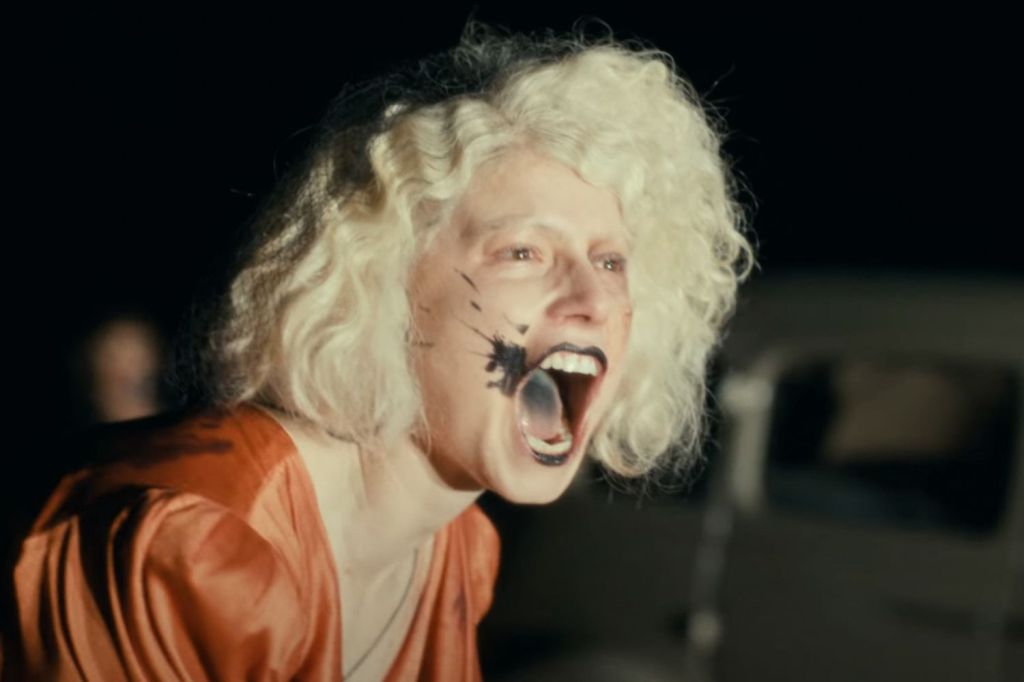
Outcasts become outlaws in an imagining of a possible sequel of Mary Shellely classic tale directly from herself. The film is a rich blend of the French new wave of the sixties, and the new Hollywood of the early 70’s. The endearing quality is to capture the sensation of the story then just tell the story. It’s more an emphasis of a feeling, a mood, than a structure. Although it does have a story, the tone is more of the focus. The action is the substance rather than the practicality. The film is a housing for a loose playground for the actors and crew to explore and freely play. It’s definitely an actor’s film. The catalyst for this film is the idea that Mary lived in an era of storytelling that restricted and constrained her to that if written in the 1930s would be more relaxed. The Bride plays like a surreal fever dream where unscripted dance numbers are always around the corner. As if we are watching a rough sketch of an idea of a story from Mary Shelley herself for the afterlife.
This is another vessel to cement Jessie Buckley as one of the best actresses working in the industry, period. She is absolutely captivating throughout playing not only the bride but also a haunting consciousness of Mary Shelley’s ghost in the afterlife. It’s important to note that its not Buckley that great in this-the acting from the entire ensemble cast is terrific.
The slight problem with the film is that it is a messy script. Many times it prefers to use dance routines for an ex-machina, and the notion of Mary Shelley’s ghost driving the narration just doesn’t work and feels too pretentious to meld into the whole film’s concept. The script feels too safe for an outrageous concept. The subplot of the duo detective team of Peter Sarsgaard and Penelope Cruz can’t shake its perceived notion of merely being an add-on to extend the film’s length rather having an important to say for the film.
The main point of the film is that sometimes, art just to do art can be the revolution. For the film is not challenging the art of film. It’s not going to be a monumental achievement of film. It’s not made to be critics darling or to win awards- it was made for that. It was made to make art and is aware of it. And that concept is where it will eventually give birth to all the themes that the film wants to have a discussion about. Like feminism, class, loneliness and patriarchy. There is real an enduring characteristic to this. a sense of being memorable forever those who see it. It is very unique, very much alone in definition, although many will compare it to Arthur Penn’s “Bonnie and Clyde” of 67, and rightfully so, but as the bride says in this film “I prefer not to.” 8/10
 St Paul Filmcast Reviews
Leave a comment