
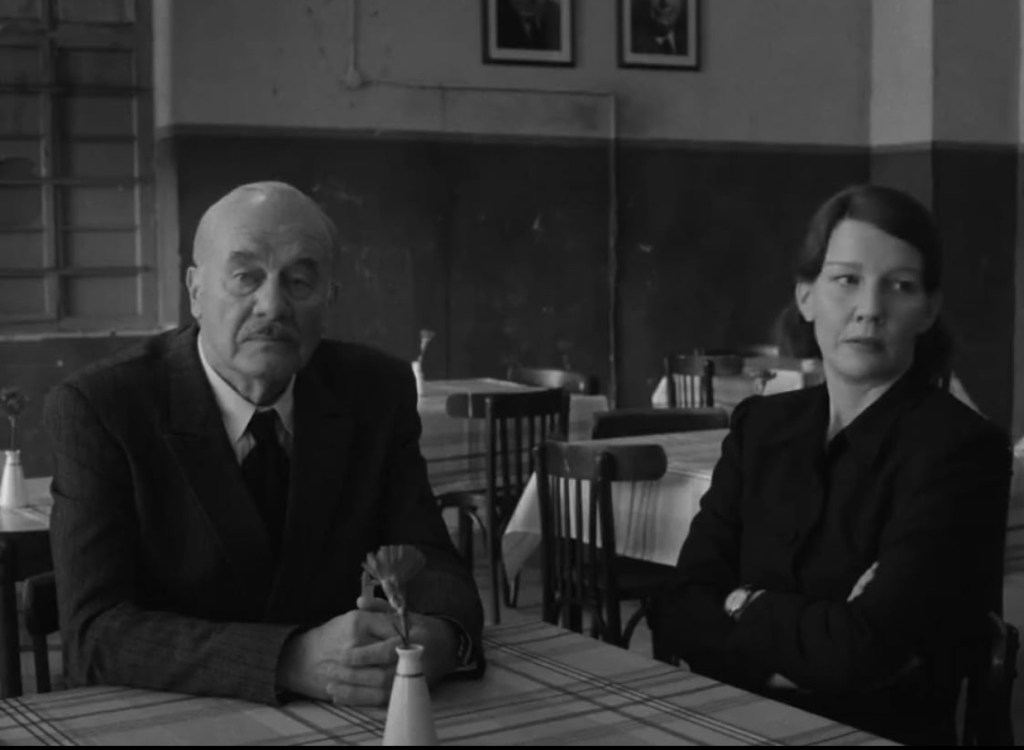
Being the third of Pawel Pawlikowski’s historical films “Fatherland” maintains the rich, and still black and white aesthetic. The camera remains unnerved, steady. It’s nearly motionless throughout. It is the subtle action inside the frame that keeps our interests. Pawlikowski’s previous film “Cold War” was one of my top ten favorite films of 2019 and one the top ten best of the 2010s (revealed on a previous episode of the show St. Paul Filmcast with Film critic Kyle Goethe a few years ago). Pawlikowski earned best director at Cannes this year-the 79th. Here, Pawlikoski shortens the script and tightens the lens to one of the best films of the year.
“Fatherland” is one of the most gorgeous, but also the most eloquent films of the year. It is a result of an artist in control of his craft and style. Pawlikowski keeps it simple and doesn’t busy up the film. Black and white is the subtraction of distraction and he uses that to the fullest extent. The production design is sparse, the lens is deep, and it is painfully balanced.
It’s 1949, The story of Thomas Mann, an exiled philosopher and writer returning to Weimar to claim the Goethe Award is the catalyst, but it is his daughter Erika that is the fulcrum to the story. Sandra Huller presents the loss and bewilderment of what is occurring. Her famed brother Klaus-who wrote the banned book “Mephisto” has committed suicide. Her father is a possible traitor and seems possibly unearned to receive the award. Erika perceives some dishonesty about the whole thing. She meets her ex-husband at a social function and he confesses his close proximity to Nazi. SHe slaps him. The vacancy is in her soul. Are they really returning home? Can they? Or are they being played into something for someone else’s ambitions? Trust is hard to come by even four years after WW2 has ended.
Sandra Huller should be nominated for best actress for this. The multiple layers of emotions she emits out without words is a master class of acting. The camera work is deceivingly simple. It is bleak and beautiful. This also has the greatest ending to his films. The setting and the starch presentation delivers a heavy blow. The exhaustion of fighting fascism, fighting politics, fighting for their convictions they can only weep at the dilapidated church. So touching and so not over done that another director would have tried a more fancy approach. Pawlikowski keeps it deceivingly simple.
“Fatherland” is a director at the top of his vision and artistry. The minus of a film score provides another sense of emptiness and hollowness to the film. It also forces the viewers to maintain focus on the vision, and the vista. The scope is outstanding, the editing smooth and nearly flawless. Pawel Pawlikowski deserves best director of the year for it. 9.5/10



Leave a Reply